Melmoth
Three Bags FullMelmoth is the legendary ram whose disappearance has made him both a cautionary tale and an object of wonder to the flock. Twin brother of Sir Ritchfield, he returns after years away, bringing a history of dangerous solitude, a complicated bond with Othello, and a way of teaching that challenges the flock’s fear of leaving its familiar pasture. His second disappearance repeats the first, but this time Othello knows how he went—and chooses not to tell.
Identity and the Legend
Melmoth is Sir Ritchfield’s twin brother, a ram remembered as having disappeared. Before he returns, his absence lives on in the flock as a story mothers whisper to lambs: a frightening account without a reassuring haystack in which to hide. The lesson attached to it is blunt. Sheep who leave the flock, approach the cliff tops, or eat strange fodder may never come back. Melmoth’s name thus stands for the danger that the flock cannot explain or control.
The warning becomes more immediate when Miss Maple considers the possibility that Tess has run away after George’s death. Sir Ritchfield invokes Melmoth to make a younger ram respect his authority, treating the old disappearance as a consequence to fear. Later, when Cloud says that Melmoth went away, Sir Ritchfield insists that his brother is dead. He recalls George going to look for Melmoth with the butcher’s dogs, and says George returned smelling of death. On the fifth night, Sir Ritchfield waited alone by George’s shepherd’s caravan and again smelled death. His conclusion, that no sheep may leave the flock, turns a personal memory into a rule for everyone.
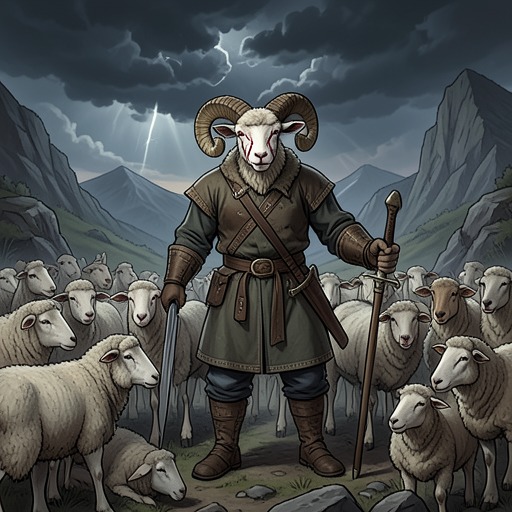
When Melmoth finally appears, the flock sees more than a missing ram restored. His resemblance to Sir Ritchfield makes it difficult to tell the two apart, and the confusion briefly makes leadership seem impractical: the sheep cannot have two lead rams, even if they look like the same one. At the same time, the old story gives his arrival a supernatural cast. He is likened to legendary sheep who escaped shearing or were invoked to frighten lambs; a lamb who watches him helps spark rumors that he is a ghost, the Goblin King, or a wolf’s ghost. His return does not simply disprove the legend. It makes the legend seem newly alive.
Wandering and Return
The story of Melmoth’s earlier wandering gives physical detail to the danger behind the flock’s tale. One first night, he huddles in a prickly hawthorn hedge against an icy November wind and catches a cold. In daylight he roams a gray-green winter moorland, cautiously nibbling coarse grass. From a hill he searches the blue strip of sea for white woolly dots, pretending to be orienting himself. Finding no sheep and no cloud, he experiences a brief euphoria in the vastness of his solitude; when it turns to panic, he gallops wildly across the empty hills.
In another episode, flight carries him into a rocky cul-de-sac. He tries to scramble up a natural ramp of loose debris, but stones fall away beneath his hooves. The carrion eater calls off its dogs, and Melmoth understands that escape has failed. He decides, in the last seconds he believes remain to him, to stand and face the butcher. As he descends the pebbly slope, he notices a human leg bone among the stones. The account makes danger concrete without making his subsequent survival or return less uncanny: the flock has treated him as dead, but the ram they feared and mythologized is again among them.
Othello and the Work of Teaching
Melmoth’s return is especially difficult for Othello, who has been trying to track him down for years. Othello remembers a rainy night at the circus: Melmoth galloping past the tents while Othello watched from behind bars and a cruel clown lay in the mud calling for a light. Melmoth had taught him patience, how to attend to fire and water, how to watch a snail’s slimy trail, how to drive rage and fear away, and how to observe thoughts. He had also taught Othello to fight; his remembered voice had helped save Othello’s life more than once.
Yet Othello’s gratitude is inseparable from resentment. Melmoth left him behind with the clown, and Othello has never accepted the lesson that being alone can sometimes be an advantage. When they meet again, Othello hides rather than greet him. He fears that Melmoth may regard him as merely one sheep among countless others, a possibility more painful to him than other explanations. Melmoth, though aware of Othello’s presence, leaves him alone. Their reunion therefore remains unresolved: affection, dependence, anger, and uncertainty coexist without an easy reconciliation.
The flock, too, must decide whether to accept Melmoth as a teacher. Othello gathers the sheep around a hill, where Melmoth stands in the hot wind, his shaggy fleece rippling and his horns shining. Asked to name their worst enemy, the sheep list the butcher, Gabriel, the master hunter, and the wolf; Zora identifies the abyss. The exchange reframes danger: the enemy is not only a pursuer or predator, but also the drop that fear makes difficult to face. Later, Melmoth urges the flock to pay attention to what frightens human beings. Miss Maple realizes that humans put up fences. His teaching works through observation rather than force, asking the sheep to understand a threat before reacting to it.
Leadership and Change
Sir Ritchfield changes after his brother’s return. Though the flock would have preferred to keep him as lead ram, he becomes more cheerful and playful, almost as daring as a young ram, and seems less interested in leading. He stays close to Melmoth and makes a new version of his old rule: no sheep may leave the flock unless that sheep comes back again. The revision holds the memory of danger together with the fact of Melmoth’s return. It does not erase the old fear, but makes room for departure and return as part of the same experience.
Melmoth’s teaching also appears in a small demonstration of imitation. Standing on his hind legs, he marches awkwardly like a human; Othello rises onto his own hind legs and identifies the performance as a trick. The gesture gives the sheep a way to distinguish a human manner from a human being, turning imitation into a lesson in perception. Later, when the sheep think Rebecca must keep reading aloud, Melmoth interrupts their literal understanding of the will: the story, he tells them, is present in the flock itself, and the child needs the key. His intervention shifts attention from the written instruction to the living story the sheep are making.
The Second Disappearance
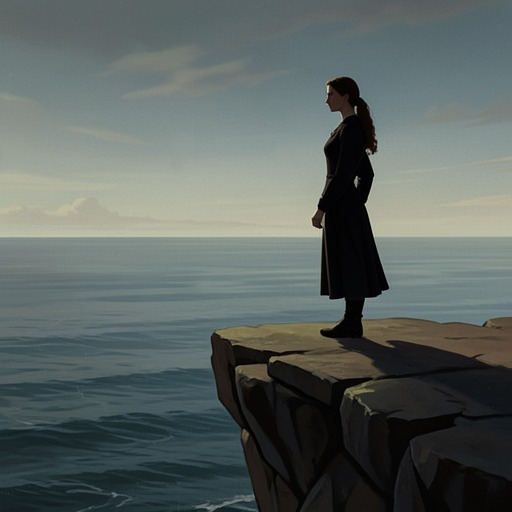
At the end, Melmoth invites the flock to the cliffs for a story about saying good-bye. They follow him, drawn by the familiar sense that his stories carry an obscure promise or warning. The crows begin to cry out, and the sheep look for a dead animal, but see none. When they turn back, Melmoth has vanished. They search beneath the dolmen, in the hay barn, behind the shepherd’s caravan, and in places he could not plausibly have reached so quickly.
The sheep imagine that he has become a cloud sheep, and watch a shaggy gray cloud with reverence and sadness. Othello knows that Melmoth has instead climbed down a steep tunnel in the rock beneath the pine tree and gone away. He does not reveal this route. In his judgment, explaining would not make the flock understand; it would make them understand less. Even Othello cannot settle what Melmoth is or how fully he understands himself, the sheep, and the shepherds. The choice to keep silent leaves Melmoth’s departure both practical and mysterious. His old lesson about solitude returns, but now it belongs to Othello as well: he has the knowledge to explain the departure and elects to remain alone with it.